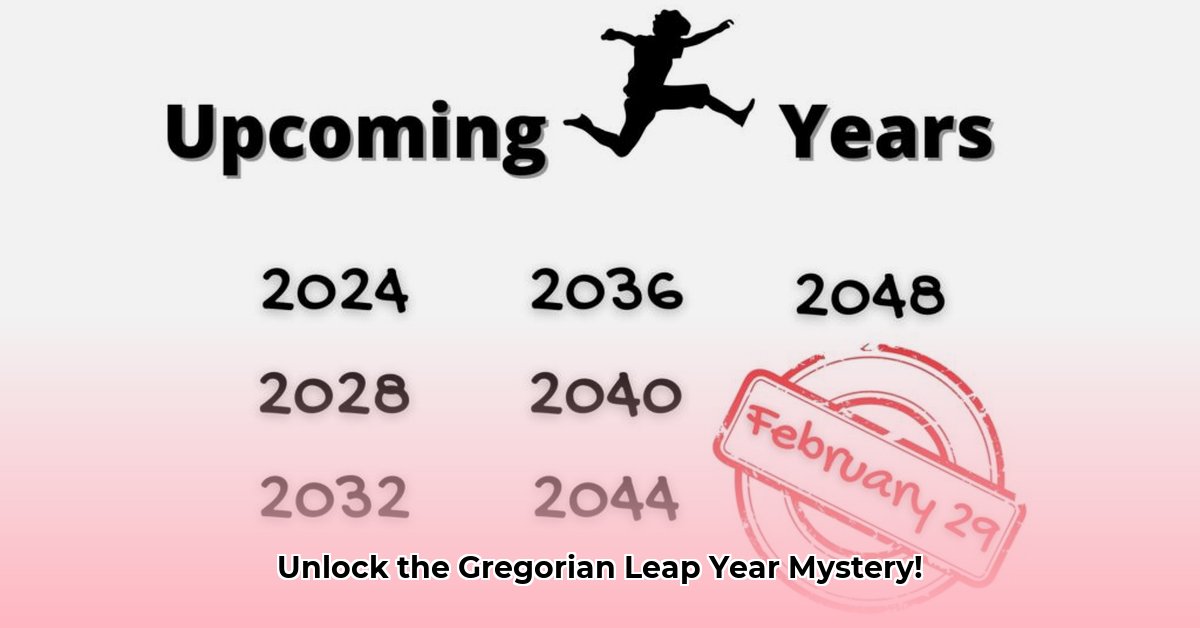
Understanding Leap Years: Why We Need Them
Ever wonder about that extra day in February every four years? It's not magic; it's mathematics! The Earth's orbit around the sun isn't perfectly 365 days; it's closer to 365.25 days. This seemingly small difference—0.25 days—adds up over time. To keep our calendar aligned with the seasons and prevent dates from drifting, we have leap years. Without them, our calendar would eventually be off by months! For a detailed look at leap years over a longer period, check out this helpful resource on century length.
The Simple Three-Step Leap Year Calculation
Determining if a year is a leap year follows a straightforward three-step process:
Step 1: The Four-Year Rule: Is the year divisible by 4? If no, it's not a leap year.
Step 2: The Century Exception: If divisible by 4, is it also divisible by 100? If yes, proceed to Step 3.
Step 3: The Four-Century Rule: If divisible by 4 and 100, is it also divisible by 400? If yes, it's a leap year. If not, it's not.
Examples:
- 2024: Divisible by 4 (Step 1), not by 100 (Step 2), so it's a leap year.
- 2000: Divisible by 4, 100, and 400 (Steps 1-3), so a leap year.
- 1900: Divisible by 4 and 100, but not 400, so not a leap year.
- 2100: Similar to 1900, not a leap year.
Did you know that only 24 of the last 400 years have been leap years? This is a crucial calculation for accurate long-term data analysis.
Practical Applications of Leap Year Calculations: Beyond the Calendar
Understanding leap years extends far beyond simply knowing which February has 29 days. It's crucial for:
Software Development: Programming languages and software applications must account for leap years to avoid date errors in scheduling, financial systems, and more. Failing to do so can lead to significant errors in calculations and predictions.
Data Analysis: Accurate time-series data analysis (e.g., stock prices, weather patterns) requires considering leap years. Ignoring this detail can skew trends and generate incorrect conclusions.
Financial Modeling: Precise timekeeping is vital for financial projections. Inaccurate leap year handling can lead to substantial discrepancies in long-term financial forecasts.
Could miscalculating a leap year impact something as large-scale as stock market predictions? Absolutely, as demonstrated by the significant errors resulting from incorrect handling of dates and time in high-frequency trading.
Using Tools for Leap Year Verification
Manually calculating leap years can be tedious. Fortunately, several tools simplify the process:
- Online Calculators: Numerous websites provide instant leap year checkers. Simply enter the year and get an immediate result.
- Spreadsheet Software: Programs like Microsoft Excel and Google Sheets have built-in functions to detect leap years.
- Programming Languages: Languages like Python and R offer libraries designed for date and time manipulations, including leap year detection.
"Using built-in functions is recommended for efficiency and accuracy," advises Dr. Anya Sharma, a Data Scientist at the University of California, Berkeley.
What’s your preferred method for determining a leap year? Do you prefer the quick calculation or a reliable digital tool?
Key Takeaways: Mastering Leap Year Calculations
- The Gregorian calendar's leap year system corrects for Earth's slightly longer orbital period.
- The three-step rule (divisible by 4, except centuries not divisible by 400) is fundamental.
- Ignoring leap years leads to significant errors in long-term data analysis.
- Tools like online calculators, spreadsheet software, and programming libraries provide efficient solutions.
- Accuracy in handling leap years is vital across numerous disciplines.
Understanding leap years isn’t just an academic exercise; it's a critical skill in data science, software development and many other fields. By mastering these concepts, you ensure the accuracy and reliability of calculations for years to come.